Monday, 26 July 2010

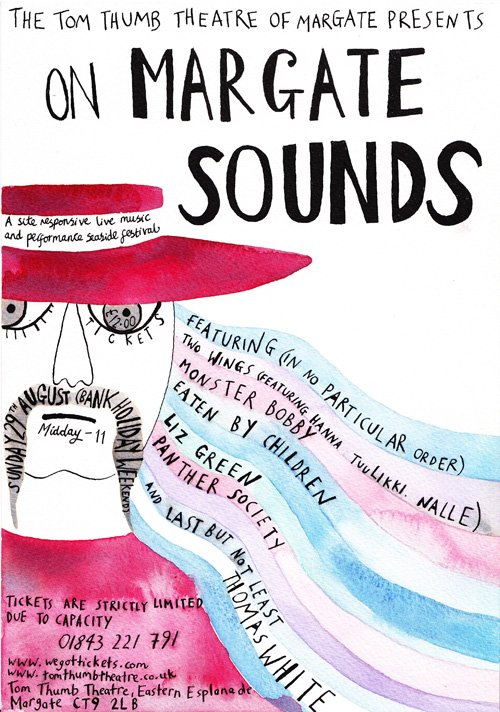
On Margate Sounds

I shall be taking part in this event at the end of August at the Tom Thumb Theatre, at Dreamland, Margate. Yes, the same Dreamland rhapsodised in Lindsay Anderson's short film, O Dreamland. You can buy tickets here - but be quick, they are very limited.

Friday, 16 July 2010

Composition (2010) No. 3

For any ensemble

Before the performance, a number of motifs taken from birdsong should be recorded and notated on manuscript paper, sufficient to assign one to each player.

All musicians should be sat in a circle, with each player having only their own birdsong motif notated on the score before them.

When you feel like it, play the motif in front of you.

Certain things should make you more inclined to play:

the sound of others playing;
any other sound in the room;
catching sight of someone you like;
a pang of hunger;
the sudden recollection of a fond memory, or a joke;
noticing someone else smiling;
an urge to go to the toilet;
feeling sunlight, or any other light, strike you, or suddenly noticing a shiny object somewhere in the room;

but you may always choose not to play.

When others play, even if you are yourself playing at that time, you must listen.

After the first performance of your own motif, you may start to incorporate material - be it pitches, rhythmic patterns or melodic shape - from any other motif you have heard since the beginning of the performance. Through this method, your own motif-string gradually extends and transforms. The longer, the more different from itself, your motif-string becomes, the more often you should want to play it and the faster it should become.

As the piece becomes more and more frantic, more and more crowded, any member of the group may give an agreed signal (which should be silent). At which point everyone should play one long note, choosing the highest note from their current (now presumably quite transformed) motif-string, lasting one long breath, after which the piece ends.

[Please contact me in the event of any performance of this piece]
Composition (2010) No. 2

For any ensemble of roughly equal numbers of each sex

All players should sit in a circle and look around the room.

Upon catching the eyes of any other player, take a deep breath and release it, playing a single note for the time it takes to release your breath.

If the person who catches your eye is female, the note you play should be a major third higher than the last note you played. If the person who catches your eye is male, it should be a perfect fifth higher.

Feel free to change octave whenever you please.

At the beginning of the piece, your hypothetical 'previous note' is a low C. If the rules dictate that your next note should be C, stop playing.When everyone has stopped playing, the piece ends.

[Please contact me in the event of any public performance of this piece]

Composition (2010) No. 1

For any ensemble of strings (and / or trombones, crumhorns, etc.)

The players should all be sat in a circle, each should imagine before him the letters

C, D, E, F, G, A, B,

in other words, the scale of C major. These are the only notes you are allowed to play throughout the piece and, excluding the opening chord, you are only allowed to play each note once.

To begin with, starting notes are:

C,
G above that C,
E above that G,
D above that G,
F above that D,
B above that F, and
A above that B.
[using only the first few lines for smaller groups, and repeating notes in the same order for larger groups]

String players will never leave their starting string, so try and pick one that gives you the greatest chance of bumping into your neighbours.

All musicians play a sustained chord on their starting notes for 7 beats, after the 8th beat, all players begin sliding up or down their chosen string in contrary motion, ceasing your glissando and holding a note only if:

You cross notes with another player, then keep sliding to the next note in C which you have not yet played and hold that note;

If you realise that to continue sliding would make it impossible to land on a note from C which you have not yet played due to the approaching extremes of the string, then simply find the next usable note and hold it;

Or, If you hear any other players have stopped sliding.

Once all four players are holding any given note they should look at each other, count for 6 beats, and then repeat, sliding in the opposite direction, pausing for consecutively fewer beats on each held chord, until finally, having reached, as it were, zero beats, the last note of the scale is held for 8 beats and the piece comes to an end.

[Please contact me in the event of any public performance of this piece]

Thursday, 15 July 2010

'In C' at The Lexington, Sunday July 11th.

Sunday last at The Lexington, A Little Orchestra and friends performed Terry Riley's minimalist classic 'In C' for John Jervis's delightful Hangover Lounge afternoon. The result was so entrancing that Mr. Sean "Fortuna Pop" Price assures me he was not once tempted to return to his newspaper. The full roll call on the day was (from left to right, see above), Robbie Knight on the synthesizer, Catherine Carr on the flute, Alex Billig on the bassoon, Paul Mosley on the euphonium, Kit Mason on percussion, Nicola Burnett Smith on the bass clarinet, Daniel Trilling on the Casio ToneBank, Dan Spanner also on the bass clarinet, Chris Guy on clarinet, Melanie Powell on viola, Dominic Simpson on another Casio keyboard, Chris Cook aka Same Actor on sitar, Greg Taylor aka Foxtrot Echo on a Casio Pt-30, and (regrettably, beyond the frame) Anne-Marie Kirby on melodica. Oh, and that's me in the middle relentlessly striking quavers on a C-note hanging from a wire coathanger and gaffa-taped to a bin. A complete recording can be heard below (I should point out that the "by" below is intended merely to express who uploaded the piece and by no means its author):
'In C' (live at the lexington: 11/7/2010) by monster bobby

Saturday, 10 July 2010

Upcoming

In about one hour, that's 16:30 BST, I will be appearing on Jonny Trunk's Resonance FM show to talk about film soundtracks and things.

Tomorrow afternoon at approximately three o'clock, A Little Orchestra and friends will be performing 'In C' by Terry Riley at the Lexington, Pentonville Road, London. It's free to get in and Bob Stanley will be DJing (and, yes, they will be showing the football later). In fact, don't just come along, download the score, bring an instrument and join in! We'll be having a quick run though at about one o'clock before anyone gets in so if you want to join in, do try and make it to that - in fact, ideally, email me first.

Next Tuesday, I will be DJing at the Lock Tavern, Chalk Farm, from about eight til about midnight. This is my Weird Music Night so you can expect bits of library music, avant-garde stuff, modern composition, horror and science fiction records and so on. This also free - and upstairs.

The following Monday, that's the 19th, The Pipettes release our new single, 'Call Me', on Fortuna Pop! To celebrate, we will be playing at The Lexington with support The School and A Little Orchestra - probably playing something other than 'In C' this time. Do come down and say hello, it would be lovely to see you.